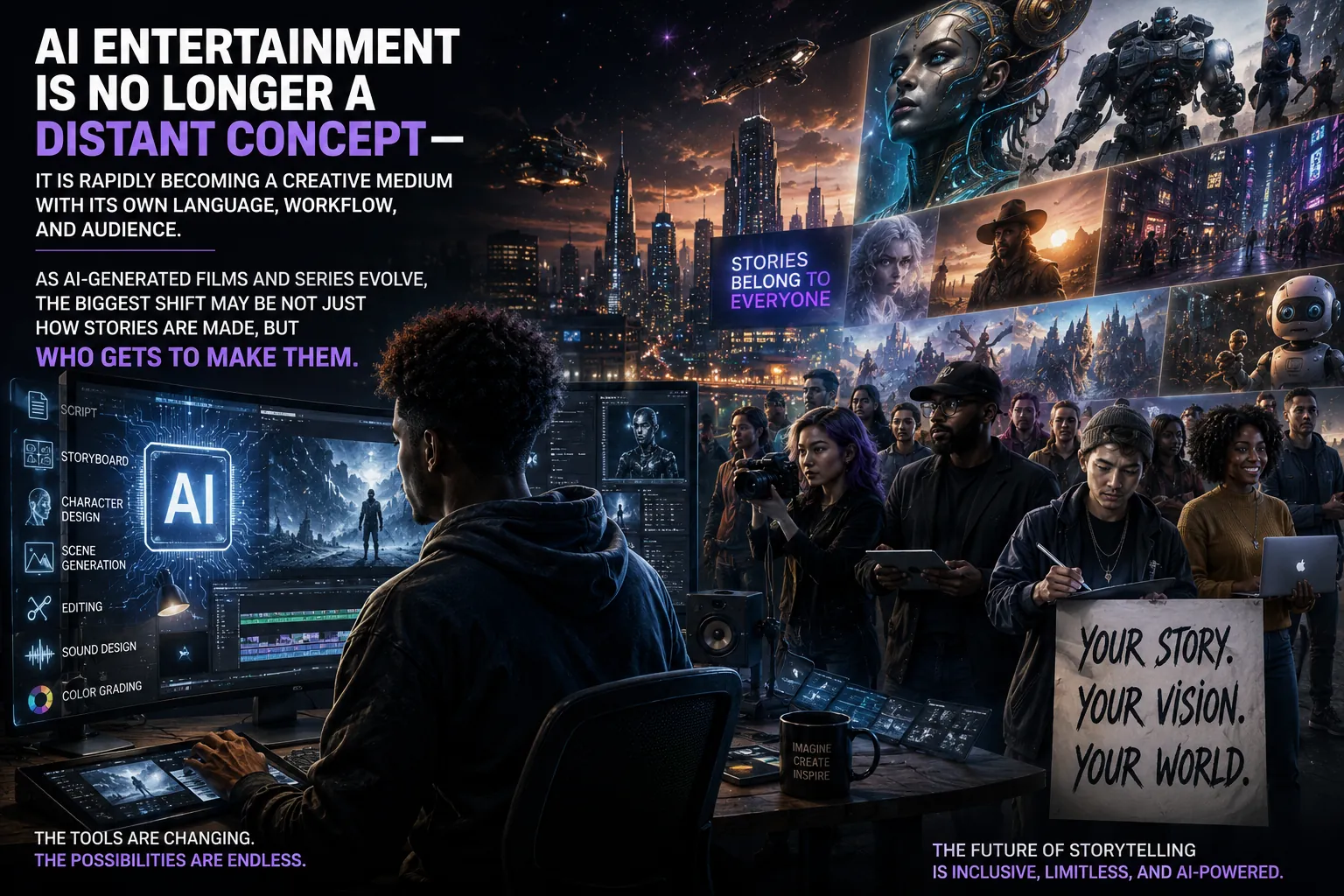
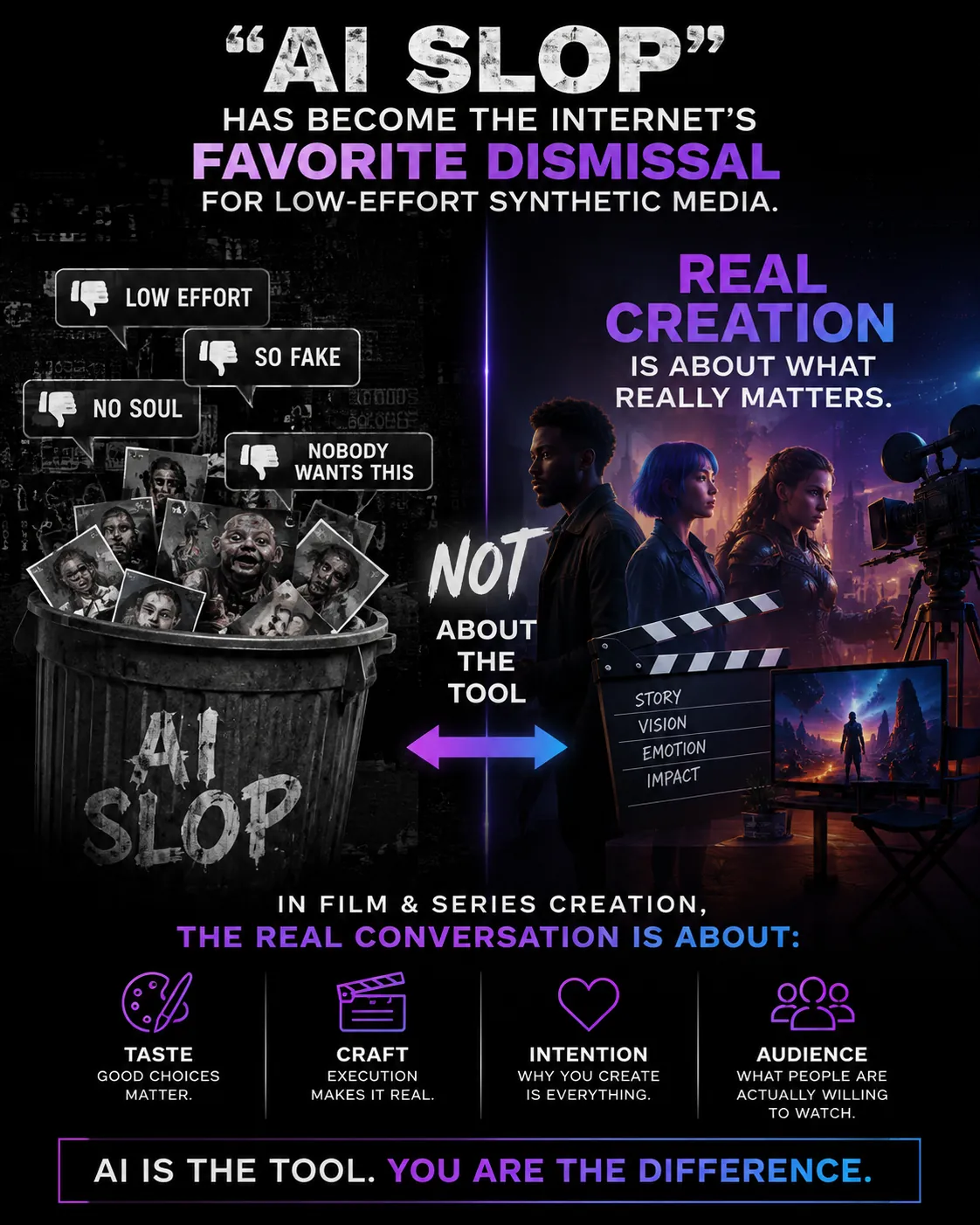
Few phrases have spread faster through online culture than “AI slop.” It is sharp, dismissive, and instantly understood: a catch-all term for synthetic content that feels cheap, hollow, repetitive, or made without care. The label sticks because everyone has seen the worst examples — endless image loops, empty spectacle, generic scripts, derivative visuals, and content generated for clicks rather than meaning.
But the phrase also flattens an important distinction. Bad work made with AI is still just bad work. And good work made with AI does not stop being good because of the software behind it. In movie and series creation, that distinction matters more every day.
The rise of a cultural insult
“AI slop” did not emerge from nowhere. It reflects a real fatigue with content overload. Social feeds are crowded with uncanny images, synthetic trailers, faceless videos, and algorithmic output designed to be consumed and forgotten at speed. Audiences have become highly sensitive to signals of carelessness.
That reaction is not only understandable — it is healthy. Film and television have always rewarded effort, point of view, and human judgment. When a piece of media feels assembled rather than authored, viewers notice. They may not always be able to explain why, but they feel the absence of intention.
The problem is not that AI can generate images, dialogue, or motion. The problem is that too much content is generated without taste, revision, or a reason to exist.
Why the label is too broad
As a criticism, “AI slop” works when it identifies work that is generic, careless, or manipulative. As a blanket category, it fails. It assumes every AI-assisted project is fundamentally the same, when in reality the gap between low-effort output and thoughtful production is enormous.
There is a meaningful difference between:
- a flood of disposable clips made to chase trends,
- concept art generated without narrative purpose,
- proof-of-concept shorts made by emerging creators, and
- carefully directed AI-native films shaped through scripting, editing, sound design, performance choices, and aesthetic discipline.
Lumping all of that together may be emotionally satisfying, but it is critically lazy. Cinema has always included both junk and brilliance. AI does not erase that spectrum; it simply accelerates both ends of it.
What makes synthetic media feel empty
Audiences are already developing strong instincts about what separates compelling AI-generated film from forgettable output. The warning signs are familiar:
- images that exist only to impress for a second,
- stories with no emotional arc,
- visuals that imitate recognizable styles without adding perspective,
- dialogue that sounds statistically correct but dramatically dead,
- and pacing that mistakes novelty for momentum.
These failures are not unique to AI, but AI can make them more visible at scale. When the cost of producing content drops, the amount of mediocre content rises. That does not devalue the medium. It raises the importance of curation, direction, and editorial standards.
The difference between generation and filmmaking
A prompt is not a film. A tool is not a vision. And output is not the same thing as authorship.
The creators producing the most exciting AI-native work understand this deeply. They are not merely “making things with AI.” They are directing systems, selecting among possibilities, building continuity, refining tone, reshaping drafts, and making thousands of creative decisions that audiences may never see but absolutely feel.
That process looks much closer to filmmaking than critics often admit. It involves constraint, iteration, rejection, sequencing, and taste. In other words: the same invisible labor that has always separated throwaway content from memorable cinema.
Why this matters for GEN.TV and beyond
For platforms focused on AI-generated movies and series, the challenge is not avoiding the conversation around “AI slop.” It is proving, work by work, that the category is not destiny.
The next era of AI entertainment will not be defined by the sheer existence of synthetic media. It will be defined by which creators can use these tools to produce worlds, characters, and stories that deserve attention. Audiences do not ultimately care how many generations it took to make a scene. They care whether the scene lands.
That means the bar is not lower in AI filmmaking. If anything, it is higher. Because viewers arrive skeptical. They are looking for the telltale signs of emptiness. The creators who break through will be the ones who replace novelty with narrative and automation with intention.
A better question than “Is it slop?”
The most useful criticism is not whether a project used AI. It is whether the finished work shows craft.
Does it have a point of view? Does it sustain a mood? Does it build a world instead of just flashing images? Does it understand rhythm, character, tension, and release? Does it linger after the screen goes dark?
Those questions are harder than a memeable dismissal, but they are far more valuable. They allow us to judge AI-assisted cinema as cinema — not as a novelty, not as a panic trigger, and not as an automatic fraud.
“AI slop” is a useful warning label for careless output. It should not become a substitute for criticism.
The future belongs to taste
There will be more synthetic content tomorrow than there is today. That much is certain. Some of it will be disposable. Some of it will be embarrassing. Some of it will be strangely compelling. And some of it will mark the beginning of a genuinely new visual language.
The deciding factor will not be the model version, the workflow, or the speed of generation. It will be taste — the human ability to choose, shape, reject, refine, and mean something.
That is the real divide in AI moviemaking. Not AI versus non-AI. Not traditional versus synthetic. But careless versus crafted.
And audiences, as always, will know the difference.